GoodData AnalyticsFeatures

What can GoodData do? We grouped its capabilities; each group is based on the vendor’s current documentation.

Connect to the data you already have

GoodData runs queries where your data lives, so you do not have to move it into another product.

  • Snowflake, Amazon Redshift, Databricks, BigQuery, PostgreSQL, Dremio, StarRocks, SQL Server, MySQL, Oracle, ClickHouse, SingleStore, Vertica, MariaDB and more
  • Works with dbt and Amazon Athena
  • Build your own connection for custom sources with FlexConnect
  • Query acceleration (FlexQuery) and the Analytics Lake
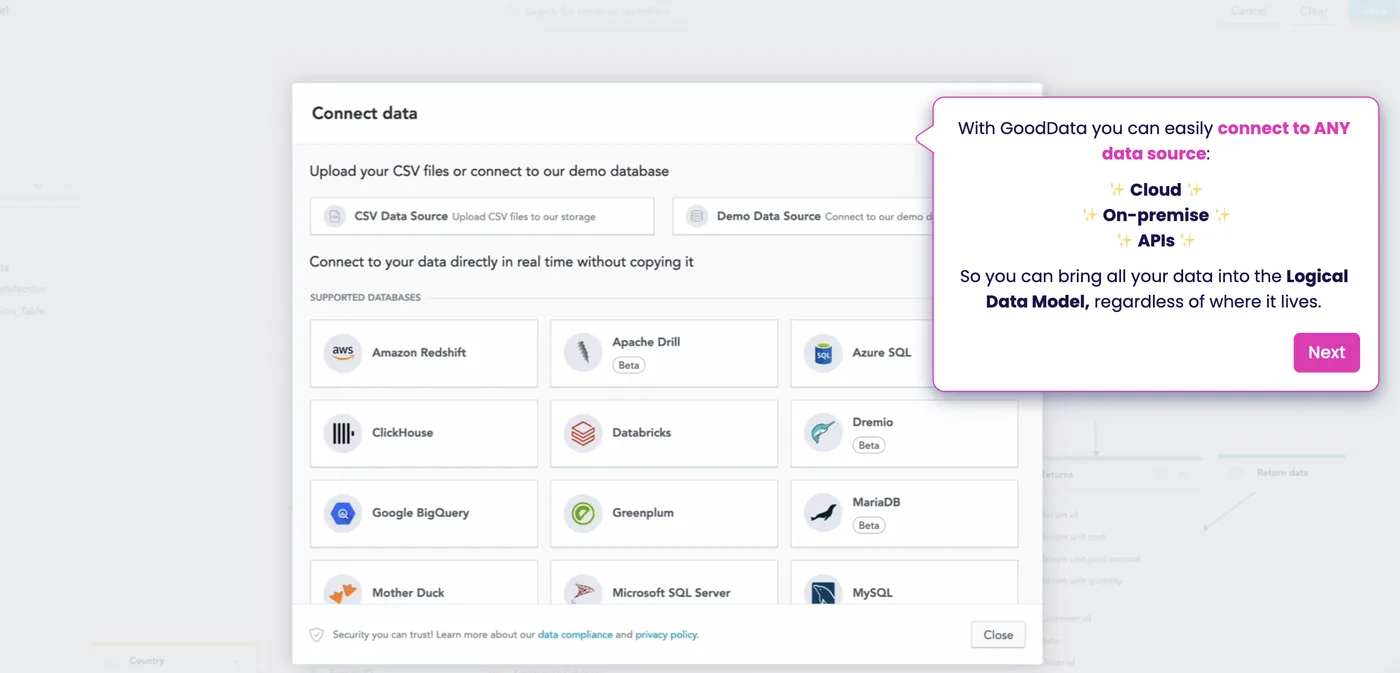
Data source connection screen (GoodData)

Semantic layer

The logical data model and the metrics are the shared source for dashboards, reports and AI answers.

  • A logical data model of datasets, attributes, facts and relationships
  • Define metrics declaratively with GoodData’s metric language (MAQL)
  • Governed metrics: agents, dashboards and APIs share the same definitions and rules
  • Inherited permissions and cascading content changes
type: metric
id: downtime_hours
title: Downtime (hours)
maql: SELECT SUM({fact/downtime_minutes}) / 60
format: "#,##0.0"
Illustrative example: a metric defined as code

Interactive dashboards and exploration

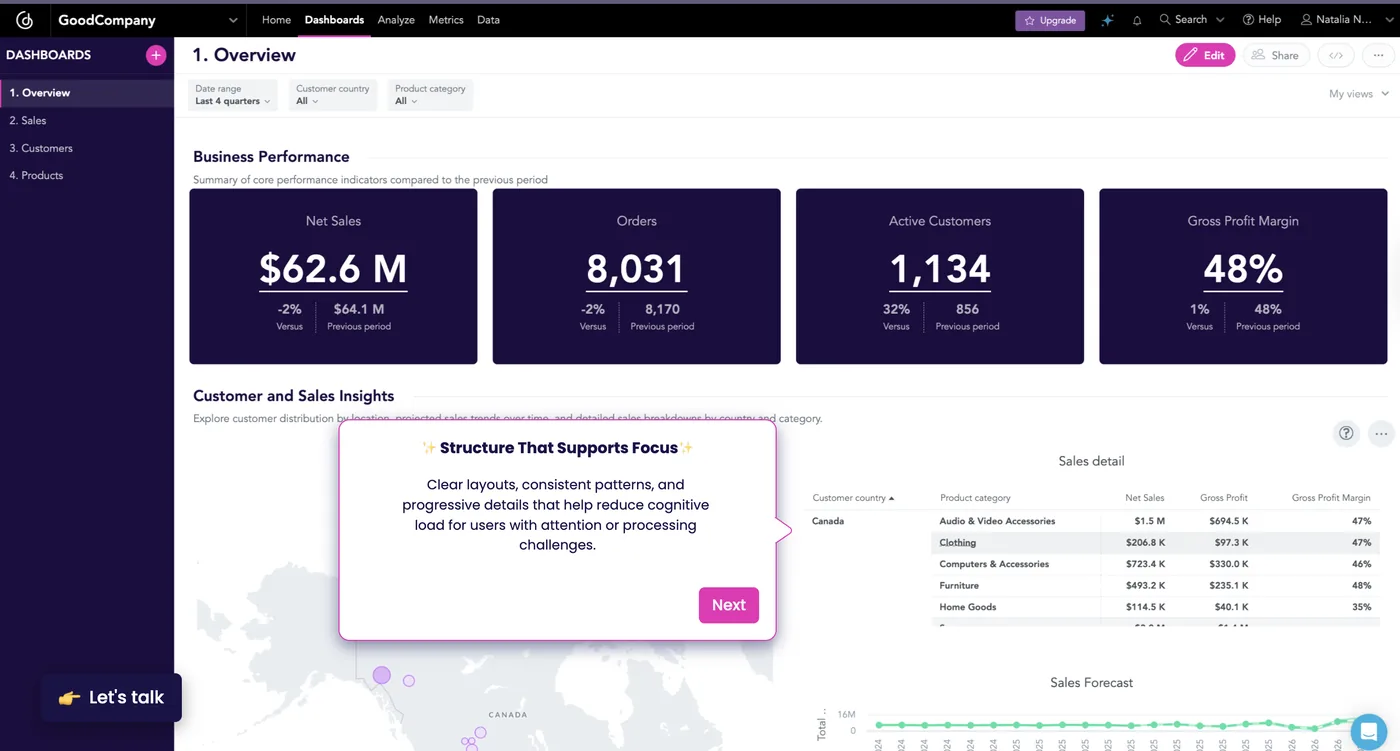
Business users can filter, drill down and build their own views without writing SQL.

  • Interactive dashboards with filters, drill-down and cross-filtering
  • Build custom insights on top of governed metrics
  • Accessibility: WCAG 2.1, EN 301 549, PDF/UA and Section 508 targets
A GoodData dashboard (GoodData)

Analytics as code

Define models, metrics and dashboards as code and bring software discipline to analytics.

  • Definitions in JSON or YAML, created and updated through the CLI or API
  • Versioned in Git: diffs, reviews, rollbacks; GitHub, GitLab, Bitbucket and Azure DevOps integrations
  • Automated deployment through CI/CD; create workspaces programmatically with the Python SDK

Embedded analytics and headless BI

Bring analytics into the application your users already work in, or use the semantic layer from any tool through the API.

  • React SDK and Python SDK; open APIs and an API reference
  • Headless BI: consume governed metrics in your own interface or in other tools
  • Users reach insights without leaving their workflow

Multi-tenancy

One model, many customers or plants: a workspace hierarchy passes the definitions from a parent workspace down to child workspaces.

  • Child workspaces use the parent’s logical data model, analytical model and data sources in read-only mode
  • Workspace data filters limit which subset of the data each tenant sees
  • A new entity added to the parent becomes available in its children
  • Users can add their own metrics and dashboards on top of the inherited ones without affecting the parent or other tenants
  • Parent: Manufacturing model
  • Plant A (filter: plant = A)
  • Plant B (filter: plant = B)
  • Customer X (filter: customer = X)
Illustrative example: a workspace hierarchy

AI and agents

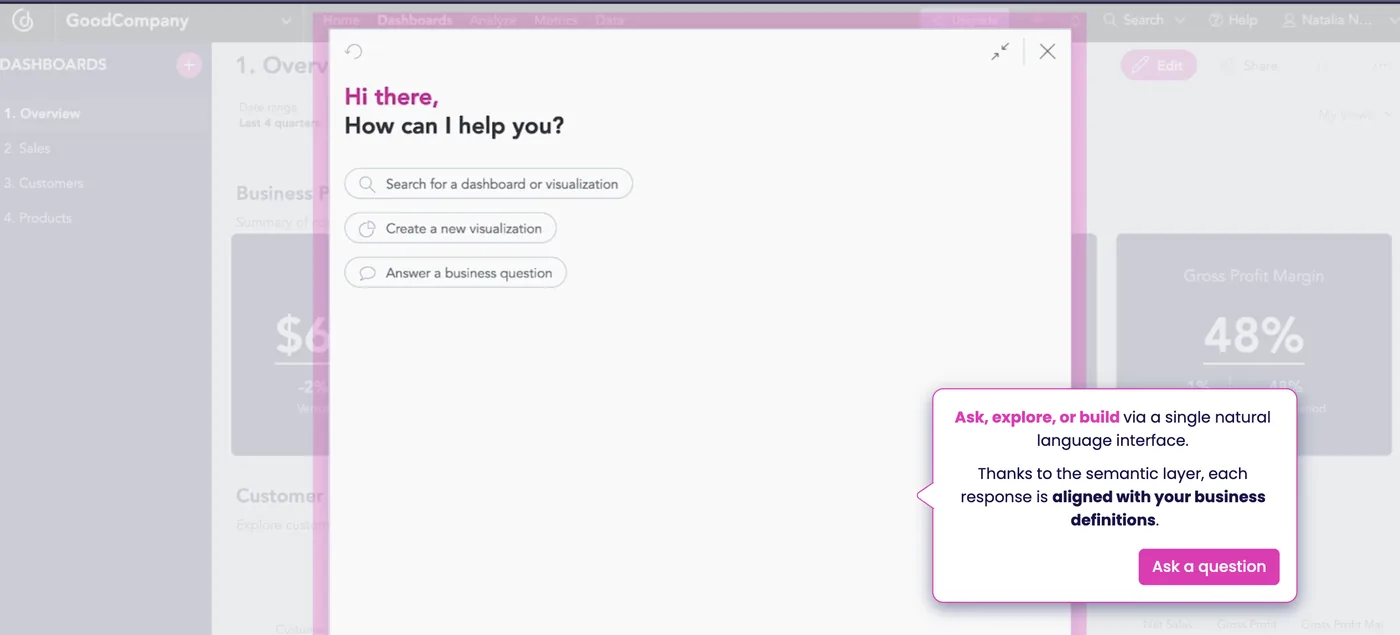
AI experiences run on the same governed metrics and context, and you can trace which data and rules shaped an answer.

  • Agents, assistants, copilots and workflows; define role, instructions and skills in the Agent Builder
  • Context management: control which data, knowledge, tools and policies each AI experience can use
  • Bring your own LLM (OpenAI, Claude, Gemini, DeepSeek, Llama, xAI)
  • MCP access from coding IDEs for analytics engineers
The AI assistant (GoodData)

Security and deployment

Cloud operated by the vendor, or the same codebase on your own infrastructure.

  • GoodData Cloud: SaaS on AWS and Azure, multi-region
  • Self-hosted: the same codebase as the cloud; Helm, Docker and Kubernetes (for data residency and regulatory needs)
  • Compliance stated by the vendor: ISO 27001, SOC 2 Type II, EU GDPR, HIPAA, FedRAMP

Together with plant data

Feed it with HighByte

Intelligence Hub delivers conditioned, modeled OT data to Snowflake or Databricks, and GoodData builds metrics such as OEE and downtime from it.

Plant and line views

With a workspace hierarchy, one plant model serves the same dashboards for every plant with plant-specific data filters.

Offer analytics to your customers

Equipment makers and service providers offer embedded analytics that shows each customer only their own data.

Frequently asked questions

What is a semantic layer and why do I need one?

A semantic layer defines the business meaning of data (entities, relationships and metrics) in one place, so every dashboard and AI answer is fed from the same definition and numbers stay consistent. See our article on the semantic layer for details.

Do I have to move my data into GoodData?

No. GoodData connects to where the data already lives and runs queries there. For plant data the typical path is to land conditioned data from HighByte in a warehouse or lake and connect GoodData to it.

GoodData Cloud or my own infrastructure?

Both are possible. GoodData Cloud is SaaS operated by the vendor; self-hosting runs the same codebase on your infrastructure with Helm, Docker and Kubernetes. Data residency and regulatory needs decide.

Does it support many customers or many plants?

Yes. In a workspace hierarchy child workspaces inherit the parent’s model and data sources, and workspace data filters limit the data each one sees. Users can add their own insights without affecting others.

Can I keep analytics in Git?

Yes. Analytics as code lets you define models, metrics and dashboards as JSON or YAML and version them in Git, applied through the CLI or API.

How do the AI features handle my data?

You can bring your own LLM and use context management to decide which data, knowledge, tools and policies each AI experience may use. The sources and rules behind an answer are traceable.

Let’s take the first step with GoodData together

Tell us where you are and what you want to achieve, and we will outline the right scope and pilot plan. Our team replies within 24 hours.